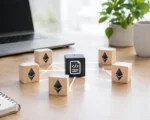
Blockchain has not disappeared in 2026, but its continued relevance depends on whether a shared, tamper-resistant record solves a real coordination problem. A recent Fast Company look at fintech, crypto, and blockchain in 2026 places blockchain among areas still being discussed after years of boom-and-bust cycles. That is a sign of ongoing attention—not proof that every proposed use is practical.
Is blockchain still a thing in 2026: what it means in practice
The short answer is yes: blockchain remains a type of record-keeping technology, and the useful question is where its design fits. For readers seeking blockchain tech explained without hype, start with the distinction between a database, a distributed ledger, and a blockchain.
A database stores and organizes information. A distributed ledger shares records across multiple participants. A blockchain is a kind of distributed ledger that groups records into blocks linked in sequence. Depending on the system, participants use a consensus process to agree on updates. The NIST overview of blockchain technology explains these building blocks, including ledgers, consensus, and cryptography.
That answers the basic question of what blockchain technology is, but not whether a particular project needs it. A conventional database may be simpler when one trusted organization controls the records. A blockchain may be considered when multiple parties need to share a record and do not want one party to manage every update.
For a concrete illustration of how the concept can work, see a blockchain technology example. The example matters less as a promise of adoption than as a way to understand the mechanics: records are shared and updated according to a network’s rules.
Is blockchain still a thing in 2026: the key factors
The phrase “blockchain” can describe systems with different participants, rules, and purposes. So “still a thing” should not be treated as a single measure of success. To evaluate a use, ask what problem it addresses, who maintains the record, and what tradeoffs come with that arrangement. This builds on these blockchain technology basics.
The core problem to understand

A blockchain does not make information true simply because it is recorded. It can preserve a history of updates under a network’s rules, but the usefulness of that record depends on the information entered, the rules for validating changes, and who can participate.
That distinction helps separate a technical capability from a real-world outcome. A shared ledger may make sense when several organizations need to coordinate records. If a single organization already has authority and participants trust its database, adding a blockchain may introduce complexity without solving a meaningful problem.
The practical decision criteria

Before treating blockchain as a solution, consider:
- Participants: Do multiple independent parties need to share or update records?
- Control: Who sets the rules, validates updates, and handles errors?
- Privacy: What information should be public, restricted, or kept off-chain?
- Cost and effort: What work is involved in building, operating, and maintaining the system?
- Alternatives: Could a standard database or another shared-ledger design meet the same need?
These questions are more useful than asking whether a project is “on blockchain.” They reveal what the system actually does and what users must trust.
Common mistakes to avoid
One mistake is treating a blockchain as a synonym for cryptocurrency. Cryptocurrency is one application of blockchain systems; the technology’s defining features concern how records are maintained and updated.
Another is assuming that decentralization means there is no governance. Networks still have rules and processes for accepting updates. The design determines who can participate and how disagreements are handled.
Finally, do not confuse an announced or discussed application with proof that it is widely used or effective. The 2026 coverage establishes that blockchain remains part of the conversation; a claim about adoption or results needs evidence specific to the application.
Is blockchain still a thing in 2026 in practice: how to apply it
Use a simple test when you encounter a blockchain claim:
- Identify the record being maintained. Is it a transaction history, ownership record, or another kind of data?
- Find out who can submit updates and who validates them.
- Ask why a shared ledger is needed instead of a database managed by one party.
- Check what happens when information is wrong, access is lost, or the system changes.
- Separate what the technology guarantees under its rules from what the organization claims it will accomplish.
This is a learning framework, not a recommendation to use or invest in a particular network or digital asset. For more foundational reading, explore these beginner blockchain guides. Readers interested in financial applications can also examine blockchain uses in finance, where the tradeoffs depend on the specific use case.
Recommended next steps
The practical answer to “is blockchain still a thing in 2026?” is that it remains relevant as a design option, not as a universal fix. Evaluate each proposal by its participants, recordkeeping needs, governance, and alternatives—not by the technology label alone.
To continue learning, define the problem first, then trace how a system records and validates information. That approach makes blockchain tech explained more concrete and helps distinguish a working technical design from a claim about what it might achieve.