
Crypto banking and decentralized finance explained: crypto banking usually describes services offered by a company, while decentralized finance (DeFi) uses blockchain-based protocols and applications. We explain how the models differ, what people use DeFi for, and what to assess before exploring it.
What crypto banking and decentralized finance mean
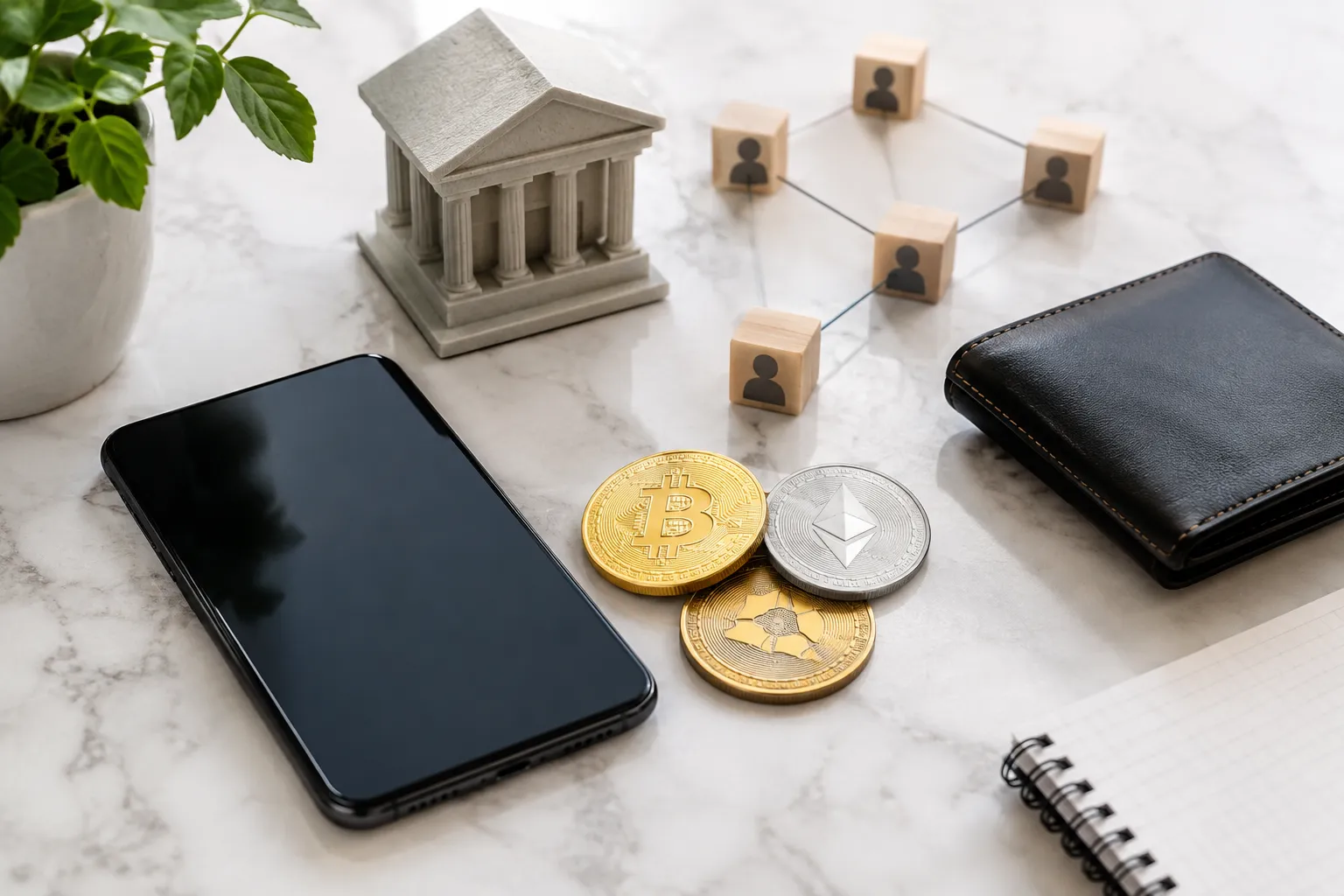
Crypto banking generally means financial services offered by a company that handles crypto or related transactions; DeFi means services run through blockchain protocols and smart contracts. Both may use cryptocurrency, but the asset, service provider, and custody arrangement are different things.
“Crypto banking” is a broad, informal label rather than one standardized product category. It can refer to services provided by a centralized company, such as a platform that holds customers’ crypto or lets them trade it. The company operates the service and may control access to the assets it holds.
DeFi is short for decentralized finance. It refers to financial services built with blockchain-based protocols, which are sets of rules for interacting with digital assets. A decentralized application, or dapp, gives users an interface for interacting with a protocol. Smart contracts—software that executes instructions on a blockchain—can carry out those rules.
The distinction in decentralized finance vs. crypto is that cryptocurrency is an asset or payment system, while DeFi describes services and applications that can use crypto. Bitcoin is a cryptocurrency with a decentralized network; owning or transferring bitcoin is not, by itself, using a DeFi service. A centralized company can also offer crypto services without becoming DeFi simply because it handles cryptocurrency.
Examples of decentralized finance include lending, borrowing, token trading, and automated payments. These examples are services built around crypto assets, not different kinds of cryptocurrency. For a broader introduction, see our guide to decentralized finance examples.

How DeFi protocols and applications work

DeFi users connect a crypto wallet to an application, choose an action, and authorize a blockchain transaction; smart contracts then process the instructions according to the protocol’s rules. The wallet signs the transaction, while the blockchain records its processing.
A typical interaction looks like this:
- Choose a blockchain network and a wallet that supports it.
- Connect the wallet to an application and check that the application and network are the ones you intend to use.
- Review the transaction details, including the asset, amount, network, fees, and any permissions requested.
- Approve or sign only if the details match your intention.
- Check the transaction status and resulting wallet activity.
A wallet is the tool used to manage keys and authorize transactions; it does not necessarily hold crypto in the way a physical wallet holds cash. In self-custody, the user controls the private keys. A seed phrase is a series of words that can help restore access to a wallet; anyone who obtains it may be able to control the assets associated with it. Do not share it or enter it into a site or message that asks for it.
Some applications ask for permission to use a token. A token approval can allow a smart contract to interact with that token, so read the request rather than treating every wallet prompt as a routine login. The approval itself is not the same as a completed token transfer, but broad or unnecessary permissions can create additional exposure if the contract or application is compromised.
A transaction is not simply a request to a bank that can be recalled later. On Ethereum, transactions are initiated, signed, and processed on the network; the specifics depend on the transaction and network. Read Ethereum’s transaction documentation to understand those mechanics. Before signing, verify the network and destination details: sending an asset on the wrong network or to an incorrect address can be difficult or impossible to reverse.
For a beginner, one application and one clearly understood action are easier to evaluate than a long list of tools. Learn what the application is asking your wallet to do before approving a transaction, and do not treat a familiar interface as proof that the underlying protocol is safe.
How DeFi compares with traditional and crypto banking
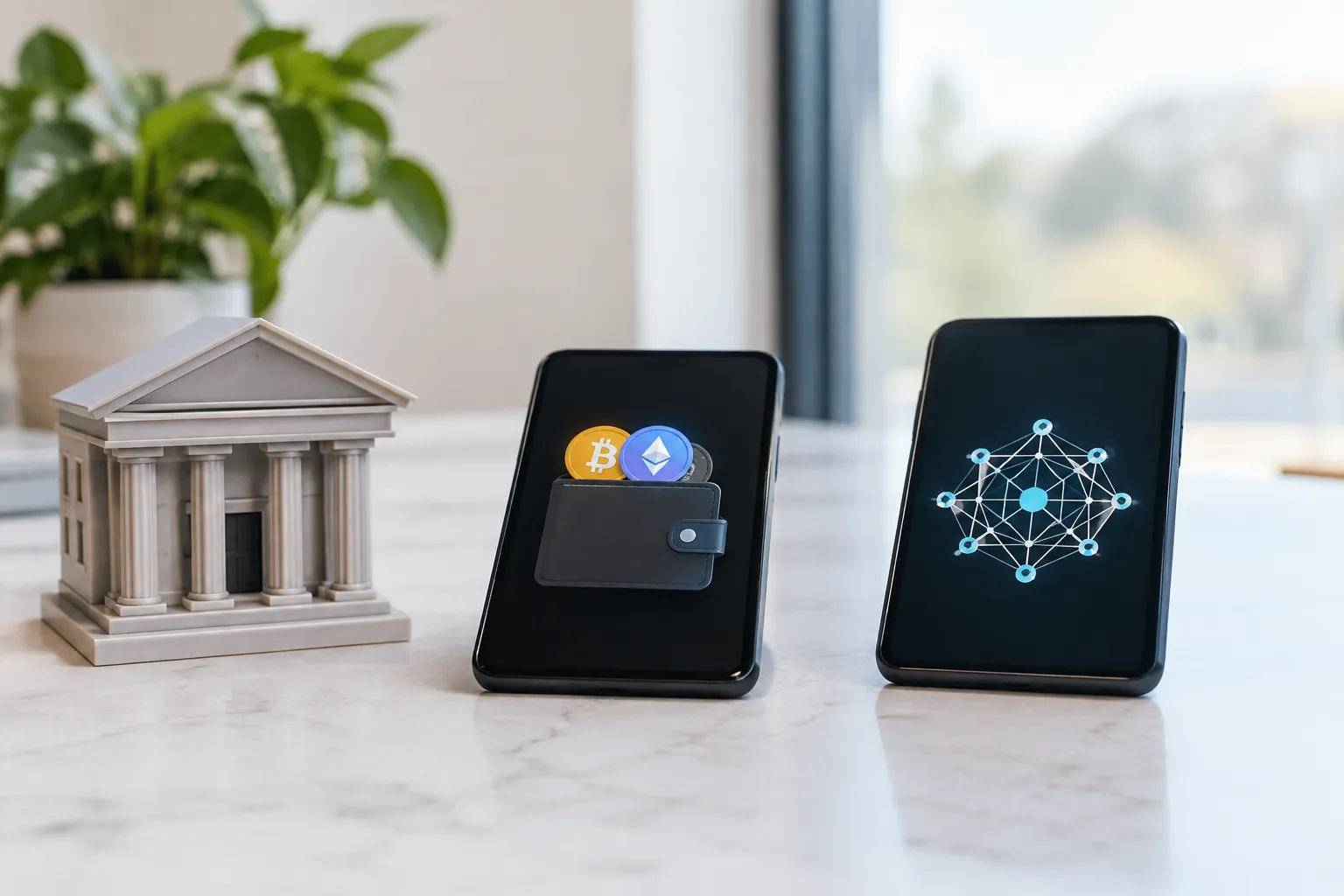
Traditional banking is provided by financial institutions, crypto banking by centralized companies, and DeFi by blockchain protocols; the models differ in who operates the service and who controls the assets. The name of an asset alone does not reveal who holds it or how a service works.
| Qualitative criterion | Traditional banking | Centralized crypto services | DeFi |
|---|---|---|---|
| Who provides the service | A financial institution | A company or platform | A blockchain protocol accessed through an application |
| How users access it | Through the institution’s accounts and channels | Through the company’s account or platform | Through a compatible wallet and application |
| Who may control assets | The institution holds or manages deposits under its arrangements | The company may hold assets on customers’ behalf | Users may retain control of their keys, depending on how they use the service |
| Common activities | Banking services such as holding deposits and making payments | Crypto custody, transactions, or trading, depending on the service | Lending, borrowing, token trading, or other protocol-based services |
| Key tradeoff | Access and protections depend on the institution and applicable rules | Users depend on the company’s operations and custody arrangements | Users take on wallet, transaction, and protocol risks |
These categories are not interchangeable. A centralized exchange or other crypto company is not automatically a DeFi protocol; its relationship to DeFi depends on how the service is operated. Likewise, using a decentralized blockchain does not mean every application built on it is governed or controlled in the same way.
Custody is a practical point to compare. If a company controls the private keys, a customer may rely on that company to provide access to assets. With self-custody, the user controls the keys and must protect them. Neither arrangement removes all risk: company failure can affect access to custodial assets, while losing control of a self-custody wallet can prevent access to its assets.
Check a service’s own terms and explanations to understand who controls keys, what happens if access is lost, and which transactions it supports. Do not assume that a crypto service offers the same protections or processes as a bank.
Common uses and potential benefits of DeFi
DeFi is used for activities such as lending, borrowing, token trading, and automated payments, with smart contracts carrying out protocol instructions. These uses can offer direct interaction with blockchain-based services, but they do not guarantee access, returns, or a successful outcome.
For example, a lending protocol may let users supply assets under rules encoded in smart contracts, while a borrowing service may let a user borrow against assets. A token-trading application can route trades through blockchain-based mechanisms. The exact process, assets, fees, and risks vary by protocol. Ethereum’s overview of DeFi services and smart contracts describes examples including lending, borrowing, token trading, and automated payments.
Potential benefits include being able to interact with a protocol through a compatible wallet and seeing transactions recorded on a public blockchain. This can give users a direct way to access some services without opening an account with a conventional financial institution. But a public record does not mean the service is easy to use, suitable for every person, or free of risk.
Some people explore DeFi because they want to use blockchain-based applications or maintain control of their keys. That control also means responsibility: users need to secure their wallet, understand the actions they authorize, and accept that mistakes may have lasting consequences. If the goal is simply to hold or transfer cryptocurrency, a DeFi application may not be necessary.
For beginners, focus on understanding a service before comparing many applications. Identify what action it performs, which assets and network it uses, what permissions it requests, and what could happen if the transaction or protocol does not work as intended. These questions are more useful than choosing based on a promise of yield.
DeFi risks, losses, and legal uncertainty
DeFi users can lose money through smart-contract vulnerabilities, scams, market movements, or protocol failures, and laws differ by location. A blockchain transaction may be difficult to reverse, so losses are not necessarily recoverable.
A smart contract can contain a bug or weakness that affects how a protocol handles assets. A protocol may also fail in ways users did not expect. Technical design can reduce certain risks, but it does not make a service risk-free. Before using an application, look for a plain explanation of how it works and what assumptions its operation depends on.
Scams can imitate legitimate applications or pressure people to share wallet recovery information. Treat unsolicited messages, unexpected links, and requests for a seed phrase as warning signs. The Federal Trade Commission explains common cryptocurrency scams and notes that cryptocurrency transactions are generally not reversible in the way a card payment may be. Its consumer guide to crypto scams also covers wallets and transaction risks.
Market movements can change the value of assets used in a protocol. Borrowing may add another layer of risk if the value of collateral changes or the protocol’s rules trigger consequences for a position. Fees and network conditions may also affect what a user receives or pays. The precise effects depend on the service and transaction.
Legal status and regulatory treatment are not uniform everywhere, and they can depend on the service, activity, and location. Do not treat the word “decentralized” as a legal conclusion or assume that a DeFi service has the same protections as a regulated financial institution. A qualified legal or tax professional can advise on how rules apply to your own situation.
How to assess DeFi before exploring it
Assess a DeFi service by checking its purpose, custody model, transaction permissions, and failure risks before connecting a wallet or committing assets. If you cannot explain what an action will do and what could go wrong, pause rather than signing.
Use this checklist before exploring an application:
- Identify the service. Write down whether it offers trading, lending, borrowing, or another function, and what you expect the transaction to do.
- Check custody. Determine whether you control the wallet keys or a company holds assets for you, and understand what that means for access.
- Verify the application and network. Confirm that you have the intended application and blockchain network, and check the destination address and asset details.
- Inspect wallet requests. Read transaction amounts and token permissions; reject requests that do not match the action you intend.
- Consider failure scenarios. Ask what happens if the protocol has a bug, an application becomes unavailable, or the value of an asset changes.
- Check relevant rules. Consider your location and activity, and seek qualified professional advice for decisions specific to your legal or tax situation.
- Limit the consequence of mistakes. Do not use assets you cannot afford to lose, and avoid adding funds or permissions just because an application prompts you to.
If a service explains its risks poorly, asks for recovery words, or presents returns as certain, stop and investigate before proceeding. A small, deliberate first step is more informative than connecting multiple applications at once, but it does not remove the possibility of loss.
DeFi FAQ
What are the key differences between DeFi and cryptocurrency?
Cryptocurrency is a digital asset or payment system; DeFi is a set of blockchain-based services and applications that can use crypto. Holding bitcoin, for example, is not by itself a DeFi activity.
Is decentralized banking legit?
“Decentralized banking” is an informal label, not proof that a service is trustworthy or legally treated like a bank. Check how the protocol works, who controls the assets, and which rules apply where you live.
What is the safest decentralized crypto wallet?
No wallet can make every DeFi interaction safe; the right choice depends on your needs and how well you can protect its keys. Compare custody, recovery options, supported networks, and transaction details before connecting it to an application.
Recommended next steps
- Choose one DeFi activity you want to understand, such as token trading or lending, and learn what a typical transaction for it does.
- Compare a protocol-based service with a centralized crypto service by checking who operates it, who controls the assets, and what happens if access is interrupted.
- Review wallet custody, recovery information, network support, and permission requests before connecting a wallet to an application.
- Read our guide to practical DeFi service examples to see how different activities work before evaluating a specific protocol.
- Decide whether the possible use fits your goals and risk tolerance, and check applicable rules before taking any action.