

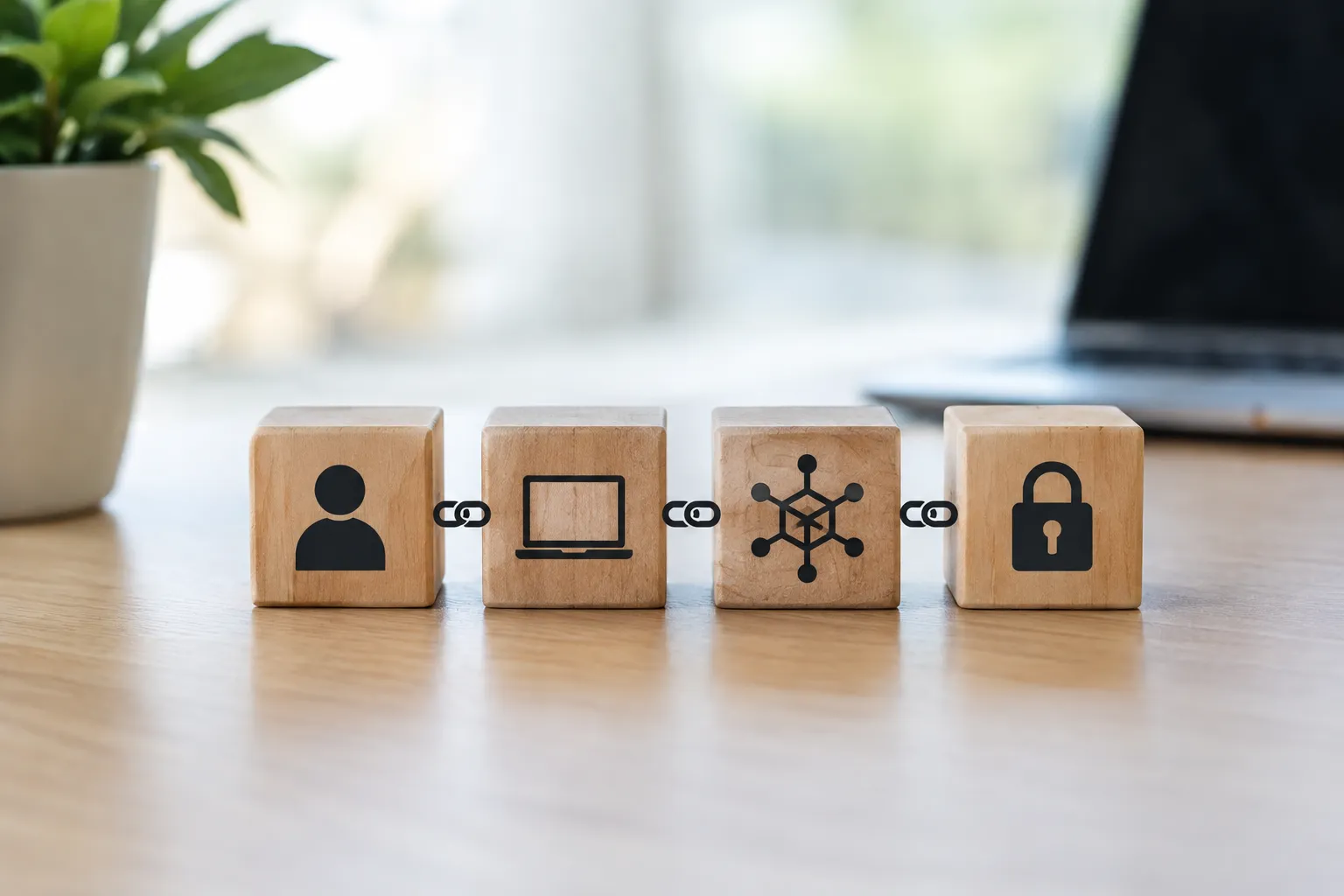
If you’re asking, “Can you give me an example of blockchain technology?” picture a concert ticket whose ownership is recorded in a shared digital ledger. Instead of relying on one company’s database to show who owns the ticket, a network of computers keeps matching records and agrees when a transfer is added.
The example helps explain what a blockchain is: a type of shared digital record in which transactions are grouped into blocks and linked in sequence. It also shows why a blockchain can be useful—and why it does not automatically make every record accurate or trustworthy.
A shared record of who owns a concert ticket

Imagine a ticketing system that records each ticket as a unique digital item. At first, its record shows that Alex owns the ticket. Alex transfers it to Jordan, and the system records that change. If Jordan later transfers it to Sam, the record is updated again.
The idea is that several computers, called nodes, maintain copies of the same record. When the network accepts a transfer, the copies are updated to reflect the new owner. Participants can consult the ledger to see the recorded history, subject to the network’s rules and privacy settings.
This is a simplified example, not a claim that every ticket needs a blockchain. A ticketing company could use a regular database and control it centrally. A blockchain becomes relevant when several parties need to rely on a shared record and want the network’s rules—not just one record keeper—to govern updates.
For a broader introduction to the topic, explore our beginner blockchain guides.
How a ticket transfer becomes part of the blockchain

The ticket example gives a practical answer to “What is blockchain?” without reducing the technology to cryptocurrency. A blockchain is a shared record maintained according to rules that determine which updates are valid and how participants agree on them. The details vary across networks; the following steps describe the general idea.
For a complementary plain-language overview, read blockchain technology explained.
A transaction records the proposed transfer
When Alex asks to transfer the ticket to Jordan, the request becomes a transaction: a proposed change to the record. The system needs a way to check that the request follows its rules. For example, it might check whether the transaction was authorized by the account or key associated with the current ticket holder and whether the ticket has already been transferred.
A digital signature can help show that a transaction was authorized using a particular private key. A private key is a secret piece of information used to authorize actions on a blockchain. It does not, by itself, prove that a person’s real-world identity is genuine or that the original ticket was issued correctly.
The transaction is shared with the network. It may wait while the network checks it and gathers it with other valid transactions.
Transactions are grouped into blocks
A block is a batch of transactions that the network adds to its record. In the ticket example, a block might include Alex’s transfer to Jordan along with other ticket transfers.
Blocks are connected in sequence. Each block refers to the one before it using cryptographic data, which makes changing an earlier record detectable under the blockchain’s rules. This structure is why people describe the record as a chain of blocks.
A blockchain does not necessarily store every related piece of information. A ticket system might keep some details—such as a person’s name or contact information—outside the chain and record only the transfer or a reference to other data. What is stored depends on how the system is designed.
Consensus updates the shared record
Before the transfer becomes part of the accepted ledger, network participants must follow a process for agreeing which valid transactions or blocks to accept. That process is called consensus.
Consensus methods differ. Some networks use proof of work, in which participants compete to add blocks through computational work. Others use proof of stake, in which participants help validate blocks according to the network’s staking rules. A private network may use a different arrangement among approved participants.
Once a block is accepted, participating computers update their copies of the record. A network can have safeguards against unauthorized changes, but consensus does not guarantee that the information entered in the first place was true. If a system records a fraudulent ticket as valid, the blockchain may preserve that inaccurate record consistently.
Where this kind of blockchain example can be useful

The ticket example is most relevant when multiple parties need to check a shared history and do not want updates to depend entirely on one organization’s record. Similar needs can arise in tracking goods between businesses, coordinating records among organizations, or managing digital assets. Whether a blockchain is appropriate depends on the problem and the network design.
There are important questions to ask: Who is allowed to submit updates? Who checks them? Who can view the record? What happens when an error needs correcting? If one organization already has authority over the information and participants trust it to maintain the database, a conventional database may be simpler.
Blockchains are also used to record cryptocurrency transactions. Cryptocurrency is a digital asset that can be transferred using cryptographic systems; the blockchain provides a record of those transfers. To understand that connection, see our guide to crypto currency.
What the example reveals about blockchain trade-offs

A shared ledger can make it easier for participants to check the same transaction history. But the benefits come with design choices and limitations.
- Transparency and privacy: Some blockchains make transaction data broadly visible; others limit access to approved participants. Even when names are not displayed, public transaction details may reveal patterns. Sensitive personal information should not be assumed private just because it is recorded digitally.
- Resistance to changes and error correction: Linking blocks can make past entries difficult to alter without detection. That can support a consistent history, but it can also make correcting an error more complicated. The system needs a process for handling mistakes, disputes, or compromised access.
- Speed: A transaction may take time to be checked and accepted. The time and capacity available depend on the network and its rules, so a blockchain should not be assumed to match the speed of a centrally managed database.
- Energy use: Energy consumption varies with the consensus method and the network’s activity. Proof-of-work systems require computational work to add blocks; other methods use different processes and have different resource demands. “Blockchain” alone does not tell you how energy-intensive a system is.
A blockchain can improve how participants share a record, but it cannot guarantee that every user, application, or off-chain process is secure. The ticket example still relies on correct ticket issuance, secure accounts, and clear rules for resolving disputes.
How to judge whether a blockchain is trustworthy
A blockchain’s recordkeeping method is only one part of trust. Before relying on a network or an application built on one, consider:
- Who controls participation? Find out whether anyone can join and help validate transactions or whether a small group of approved operators controls the process.
- How are transactions checked? Look for a clear explanation of the network’s consensus method, what makes a transaction valid, and how the system handles conflicting or invalid updates.
- What can be seen or changed? Check whether records are public, whether personal data is included, and how corrections or disputes are managed.
- What happens if something goes wrong? Understand the risks of lost account credentials, compromised keys, software errors, and interruptions to services that connect to the blockchain.
- Who is accountable? Identify the organizations or people responsible for the application, the network, and any off-chain records it depends on. A blockchain’s record does not automatically establish who can resolve a real-world dispute.
For most people, these checks are more useful than simply asking whether something “uses blockchain.” If a system involves a financial decision or a legal obligation, consult a qualified professional about your own circumstances.
Blockchain example FAQs
What are the four main types of blockchain technology?
A common classification is public, private, consortium, and hybrid blockchains. The labels describe who can access or participate in a network, but categories and designs can vary.
Is blockchain the same as Bitcoin?
No. Bitcoin is a cryptocurrency that uses a blockchain to record transactions; blockchain is the broader recordkeeping technology that can be used for other purposes.
Can a blockchain work without cryptocurrency?
Yes. A blockchain can record other kinds of updates, and some networks do not use a transferable cryptocurrency. How participants are rewarded or how the network is governed depends on its design.
Are all blockchains public?
No. Public blockchains generally allow broad access, while private or consortium networks restrict participation or visibility. The exact permissions depend on the system.
Where is blockchain data stored?
Copies of a blockchain are stored on computers that participate in the network, often called nodes. Which data each node stores depends on the network and its design.
Can people use a blockchain without internet access?
Most blockchain interactions require a connection to communicate with the network. Someone may prepare information offline, but it generally cannot be confirmed and shared with the network until connectivity is available.
How do users access a blockchain?
People typically interact with a blockchain through software such as a wallet, website, or other application. The tool sends requests to the network; users should check what permissions and actions they are approving.
Can a blockchain be used by just one organization?
Yes. One organization can operate a private blockchain, though it may not offer the same shared control as a network governed by multiple independent participants. A regular database may also suit a single organization’s needs.
Decide whether a blockchain fits the problem
A blockchain example is useful when it makes the underlying question concrete: who needs to share a record, who is allowed to update it, and how will participants agree on valid changes? The technology can provide a coordinated record, but it does not make the recorded information automatically true, private, or easy to correct.
Before adopting a blockchain-based service, compare it with a conventional database. If one trusted organization can manage updates, a database may be the more straightforward choice. If several parties need a shared history under agreed rules, examine how the blockchain handles access, validation, privacy, and errors. Understanding those choices is a practical starting point for learning what blockchain can—and cannot—do.
Articles in this topic
- What is the biggest problem with blockchain?
- What is a blockchain for dummies: a five-step guide
- Is blockchain still a thing in 2026? Uses and limits
- How blockchain works, from transaction to confirmation
- Blockchain technology in finance: practical uses and limits
- What is a blockchain in crypto, and what role does it play?








[…] a concrete illustration of how the concept can work, see a blockchain technology example. The example matters less as a promise of adoption than as a way to understand the mechanics: […]
[…] or what evidence the network accepts. To see how one blockchain differs from another, use blockchain network examples as a starting […]
[…] a clearer picture of how a shared record works in practice, see a blockchain technology example. The takeaway is not that every blockchain is slow or expensive. It is that capacity, fees, and […]