


A blockchain in crypto is a shared digital ledger: a record of transactions that participating computers maintain according to the same network rules. A cryptocurrency is an asset tracked by a ledger; the blockchain is the system that records and checks its transfers. The details differ across networks, so the name of an asset alone does not always tell you which network a transaction uses.
In practical terms, a blockchain can help you understand where a crypto transfer is recorded, who checks it, why confirmations matter, and what to verify before sending funds. Here is the core idea:
- A wallet signs a transaction using a private key.
- Network participants check whether it follows the network’s rules.
- Valid transactions are grouped into a block and added to the ledger.
- The network’s design affects how participation, fees, and transfers work.
What a blockchain means in crypto

When people ask what a blockchain in crypto is, they are usually asking how a digital asset can be tracked without one central recordkeeper. A blockchain is a type of shared ledger: an ordered record that is copied across participating computers, which follow rules for accepting and recording activity.
“Shared” does not mean every participant has identical access or responsibilities. On many public crypto networks, people can read transaction records, while particular network participants help check and add new records. The exact roles and rules depend on the network.
A ledger can record transfers between addresses, but an address does not necessarily reveal a person’s real-world identity. Addresses are identifiers used by the network; connecting one to a particular person may require information from outside the ledger.
If you are learning the wider vocabulary around crypto and blockchain, our beginner blockchain guides offer a place to explore the basics.
How a cryptocurrency differs from its ledger
A cryptocurrency and a blockchain are related, but they are not the same thing.
A cryptocurrency is a digital asset whose ownership or control is tracked using software rules. A blockchain is one way to keep the network’s ordered record of activity. Network software defines how transactions are formatted, checked, and recorded. Those rules determine what the ledger recognizes as a valid transfer.
For example, a network might track its own currency and also support additional digital assets or applications. Another network may be built around a narrower set of functions. These are differences in network design, not simply differences in the name of the asset.
It also helps to distinguish the network from a crypto wallet. A wallet is software or a device that helps you manage the keys used to authorize transactions and view information associated with your addresses. It does not hold coins in the same way a physical wallet holds cash; the network’s ledger records the asset-related activity.
A simple example of a crypto ledger
Imagine Alex wants to send a unit of a cryptocurrency to Jordan. Alex’s wallet prepares a transaction that identifies the amount and the destination address. If the network accepts the transaction and records it, the ledger reflects the updated control associated with those addresses.
The record is not usually a line that says “Alex paid Jordan.” It contains information in the network’s transaction format, such as the relevant addresses and amount. The displayed balance in a wallet is based on records the wallet reads from the network.
This example is simplified. Networks can differ in how they represent balances, transaction details, and asset ownership. The important point is that the blockchain provides a shared record that network software can use to determine whether a transfer follows its rules.
How a crypto transfer gets recorded
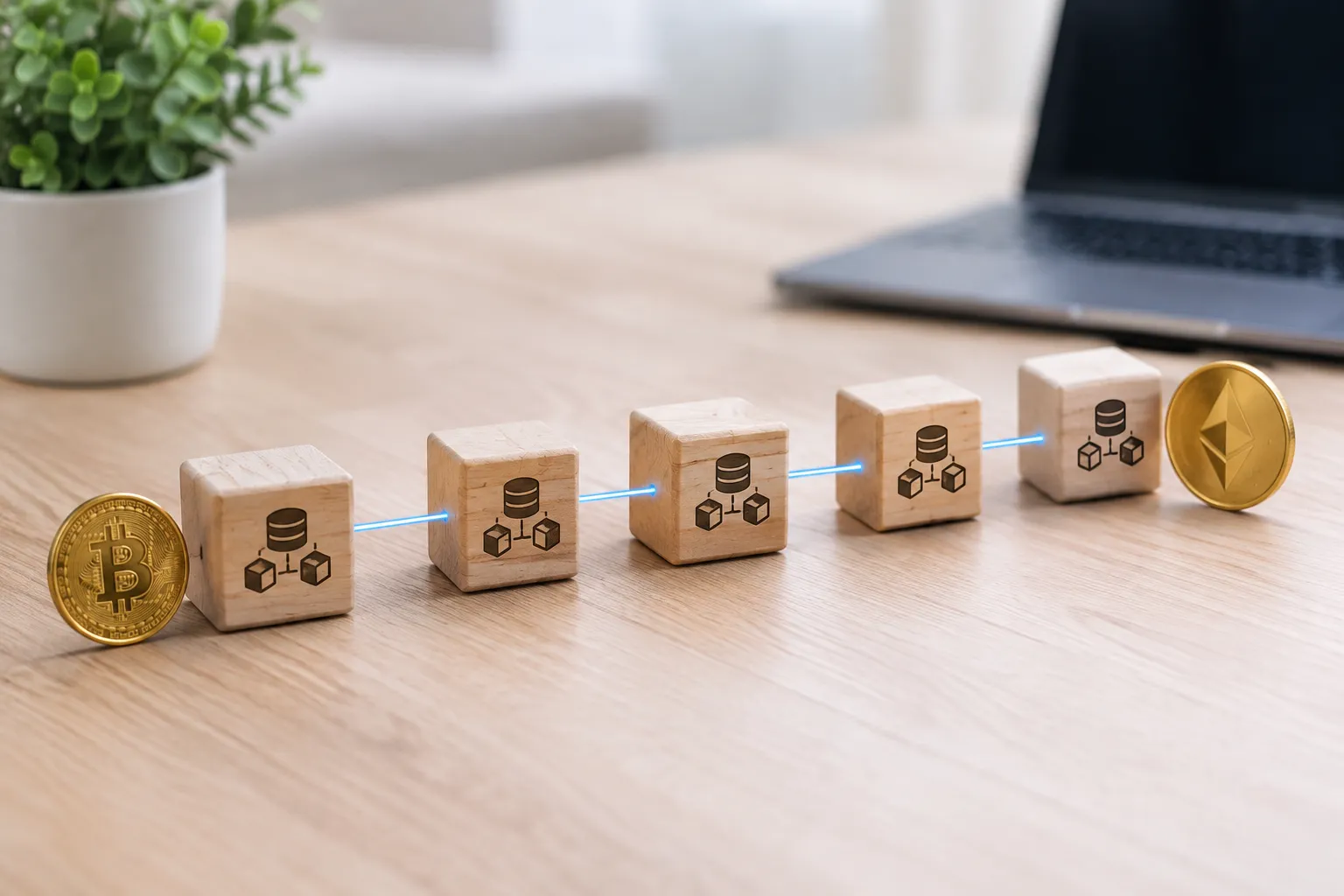
A crypto transfer involves more than typing an address and pressing send. The wallet prepares and authorizes a transaction, the network checks it, and the ledger is updated if the transaction is accepted and included in a block.
The steps below describe a common pattern, but the specific process varies by network and wallet. For a closer look at the tools involved, see our guide to crypto wallets.
Signing and sharing a transaction
A private key is secret information that allows a user or wallet to authorize certain actions for an associated address. A wallet uses the key to create a digital signature, which network software can check against the transaction. The signature lets the network verify authorization without the wallet broadcasting the private key itself.
The transaction is then shared, or broadcast, with network participants. Depending on the network and how the wallet connects, the transaction may pass through software known as a node, which communicates with other parts of the network.
Before signing, check the transaction details displayed by the wallet. Confirm the destination address, asset, network, and amount. An address is often a long string, so do not rely on a partial visual match. When practical, compare the full address using a trusted method, such as copying it directly from the intended recipient and checking the beginning and end carefully.
A malicious website, message, or application may try to substitute an address or trick you into signing an action you did not intend. Read wallet prompts rather than approving them automatically. If you are unsure what an approval allows, pause and investigate before proceeding.
Checking transactions and adding blocks
Network participants check proposed transactions against that network’s rules. Depending on the system, checks can include whether the signature is valid, whether the transaction is properly formatted, and whether the sender can authorize the requested transfer.
Valid transactions may be collected into a block, which is a batch of records added to the chain. Participants responsible for proposing or validating blocks follow the network’s consensus rules. Other participants can check whether a proposed block meets those rules.
If a transaction is invalid or conflicts with the network’s rules, participants should not accept it as a valid record. What counts as invalid, how blocks are proposed, and which participants perform checks are specific to the network’s design.
Confirmations and the updated balance
When a transaction is included in a block, it has been recorded in the ledger. Wallets and services often describe this as receiving a confirmation. Additional blocks built on top of that block can provide further confirmation that the transaction is part of the network’s accepted history.
The meaning of a confirmation and how many a service requires vary. Network conditions and the policies of an exchange, wallet, or other service may affect when it treats a transfer as complete. A transaction shown as pending has not necessarily reached the same status as one included in a block.
After a transaction is recorded, a wallet can read the updated ledger information and display a changed balance. If the balance looks wrong, check the selected network, transaction status, and address before assuming the transfer failed. A wallet’s display is an interface to network data; it is not itself the ledger.
How networks agree on the ledger

A blockchain needs a way for participants to coordinate on which transactions and blocks follow its rules. This coordination is often described as consensus. It helps a network maintain one accepted transaction history even though the ledger may be checked or stored by many independent participants.
Consensus rules and network participants
Consensus is the process a network uses to agree on accepted records. The rules specify how new blocks can be proposed, checked, and added. Different networks use different methods and assign different responsibilities to participants.
For example, some networks use proof of work, where miners compete to propose blocks by performing computational work. Others use proof of stake, where validators participate under rules involving stake. These are broad descriptions, not a full account of either system. A network’s actual requirements and safeguards depend on its protocol.
The word “decentralized” is not a guarantee that every network is equally open or that control is distributed in precisely the same way. To understand a specific network, look at who can participate, what software rules apply, and how changes to those rules are coordinated.
Why past records are difficult to change
Blocks are linked using cryptographic references to earlier blocks. If someone altered information in an older block, the references and later records would no longer line up as expected. Network participants can check the resulting history against the rules they follow.
This structure, along with the network’s consensus process, can make changing accepted records difficult. But “difficult” is not the same as impossible. The practical security of a particular blockchain depends on its design, the participants involved, and the conditions affecting the network.
A blockchain also cannot prevent every problem around it. Someone might lose access to a wallet, send funds to the wrong address, or be tricked into authorizing a transaction. Those risks involve users, software, or services as well as the ledger itself.
Why crypto projects use different architectures

A blockchain’s architecture is its overall design: who can participate, what activity the ledger records, and how participants reach agreement. Crypto projects make different choices because they may have different technical goals and operating requirements.
Open networks and restricted-access ledgers
A public blockchain is designed to make participation or ledger access broadly available under its rules. A private blockchain restricts participation, access, or both to a defined group. Permissioned describes a system where particular activities are limited to approved participants; such a system may be public or private in other respects.
These labels can be used differently across projects, so check what they mean in context. Ask whether people can read the ledger, submit transactions, operate a validating node, or take part in decisions. Access to one of these functions does not automatically mean access to all of them.
Crypto networks commonly use open participation in some form because their purpose may include allowing users to transact without relying on a single organization to maintain the ledger. The precise degree of openness varies. A project’s description is a starting point; its technical rules determine how participation works in practice.
Different rules for transfers and digital assets
Networks do not all record activity in the same way. Their transaction formats, supported assets, and available functions can vary. Some are designed primarily to record transfers of a native currency; others can also support additional tokens or applications.
A token is a digital asset created or represented using the rules of a network. It may rely on that network’s ledger rather than having a separate blockchain of its own. The token’s rules can define matters such as its name and how transfers are handled, while the underlying network determines how transactions are processed and recorded.
These distinctions matter when you use a wallet or service. A network may support an asset format that another network does not. A displayed asset name or ticker alone may not tell you which underlying network is being used.
One cryptocurrency, one network assumption
It is easy to assume that a cryptocurrency name always refers to one network. That assumption can be wrong. An asset may be represented or made available on multiple networks, sometimes through different forms or processes.
Before sending, compare the network selected by the sender with the network supported at the destination. Confirm the asset and the recipient details as well. If the two sides do not support a compatible network and asset format, the receiving service may not credit the transfer as expected. Recovery may be difficult or unavailable, depending on the circumstances.
Do not treat matching asset names as proof that two addresses or networks are compatible. If you are unsure, pause and check the wallet or service’s network instructions. For a transfer you cannot afford to lose, a qualified professional should be consulted for advice about your specific situation.
What blockchain design means for crypto users

A blockchain’s rules affect how a transfer is processed and what information the ledger makes available. They also shape practical considerations such as fees, confirmation expectations, and who can participate. Understanding those details can help you read a wallet’s network information more carefully.
Trade-offs in speed, cost, and openness
Networks make different design choices, and those choices involve trade-offs. For example, rules that support broader participation may differ from those in a system with restricted access. The way a network orders and processes transactions can also affect how quickly activity is included in a block and what users pay to submit it.
Fees, timing, and network conditions can change. A wallet may display an estimated fee or status, but that information is tied to the network and transaction at that moment. Check the details in the wallet before you confirm, and be cautious about relying on a general claim that one network is always faster or cheaper.
There is no single architecture that is best for every purpose. The useful question is whether a network’s rules and trade-offs make sense for the particular transfer or application you are considering.
What a blockchain does not guarantee
A blockchain can record activity according to its rules. It does not guarantee that a cryptocurrency will keep a particular value, that a recipient is trustworthy, or that a transaction will be reversible if you make a mistake.
It also does not remove every security risk. Wallet software, websites, devices, and user decisions can all create risks outside the ledger’s recordkeeping function. A transaction may follow the network’s rules while still being sent to the wrong address or made under a misunderstanding.
Treat the ledger as a way to record and check activity, not as a promise of safety or value. Verify the network and transaction details, protect wallet credentials, and understand what you are being asked to authorize.
Blockchain FAQs
Is blockchain just a type of database?
A blockchain is a type of database, but it is organized as linked blocks and maintained according to network rules. Unlike a database controlled by one administrator, a public blockchain can be checked and updated by multiple participants.
Can a blockchain transaction be reversed?
A confirmed blockchain transaction generally cannot be reversed through a simple chargeback process. A recipient may send funds back in a separate transaction, but the original transfer remains in the ledger.
Who checks whether a crypto transaction is valid?
Network participants check transactions using the blockchain’s rules. The specific participants and validation process vary: some networks rely on miners, others on validators, and other designs use different roles.
Can a cryptocurrency exist without a blockchain?
Yes. A digital currency can be tracked using another type of ledger or recordkeeping system. Many cryptocurrencies use blockchains, but the word “cryptocurrency” does not require every system to have the same architecture.
What happens if I send crypto using the wrong network?
The receiving service may not recognize or credit the transfer, and recovery can depend on the networks and service involved. Check network compatibility with the recipient before sending; matching asset names are not enough.
Can a blockchain be hacked?
A blockchain can face attacks or vulnerabilities, but the risks depend on its design and surrounding software. Wallet compromises, scams, and user errors can also lead to losses without the blockchain itself being altered.
Why do some blockchain transactions have fees?
Some networks charge transaction fees to process or include activity in blocks. The amount and how it is calculated vary by network and can also depend on network conditions.
Can I buy a blockchain?
No, a blockchain is a network and ledger system, not an asset you buy. People may acquire a cryptocurrency tracked on a blockchain, but the network itself is not the same as that currency.
How to read a crypto network before using it
Before sending or receiving crypto, identify the network behind the asset and check how the wallet or service handles it. A brief pause to review the details can help prevent a mismatch between the sender’s and recipient’s systems.
Use this checklist:
- Identify the asset and the network. Do not rely on the asset name alone.
- Check that the receiving wallet or service supports that network and asset format.
- Compare the selected network on both sides of the transfer.
- Verify the full destination address using a trusted method.
- Read the wallet’s transaction details, including the amount and any displayed fee.
- Confirm what you are authorizing before signing, especially if the request is unfamiliar.
- After sending, use the transaction status and confirmation information to understand whether the ledger has recorded it.
When exploring DeFi, this habit applies to more than simple transfers. Applications can request signatures or permissions related to your wallet. Read the request and make sure you understand the action before approving it.
Once you know which ledger records an asset’s activity, a crypto transfer becomes easier to follow: the wallet authorizes it, network participants check it, and a block records it under that network’s rules. That is the practical role a blockchain plays in crypto.








[…] question is whether a shared record solves a coordination problem among participants. Our guide to blockchain in crypto explains the technology’s relationship to cryptocurrency; here, the focus is how similar […]
[…] Apply the steps to one transaction by checking its details and status on the correct network. If you want more background before tracing it, read what a blockchain is in crypto. […]